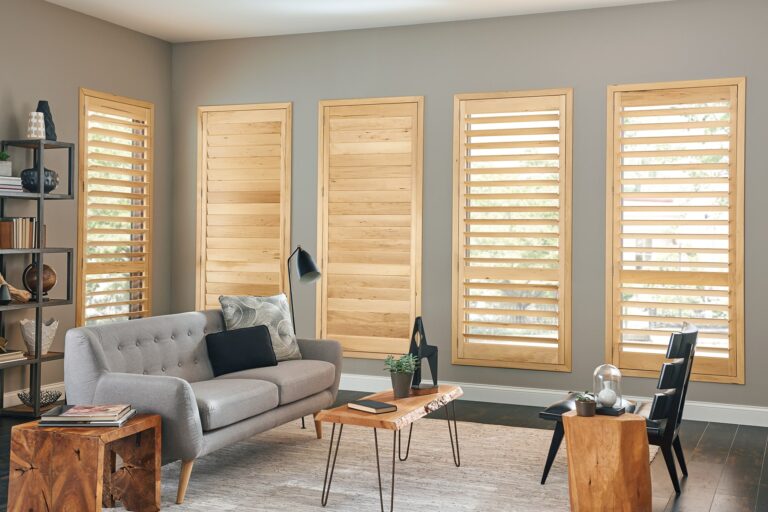

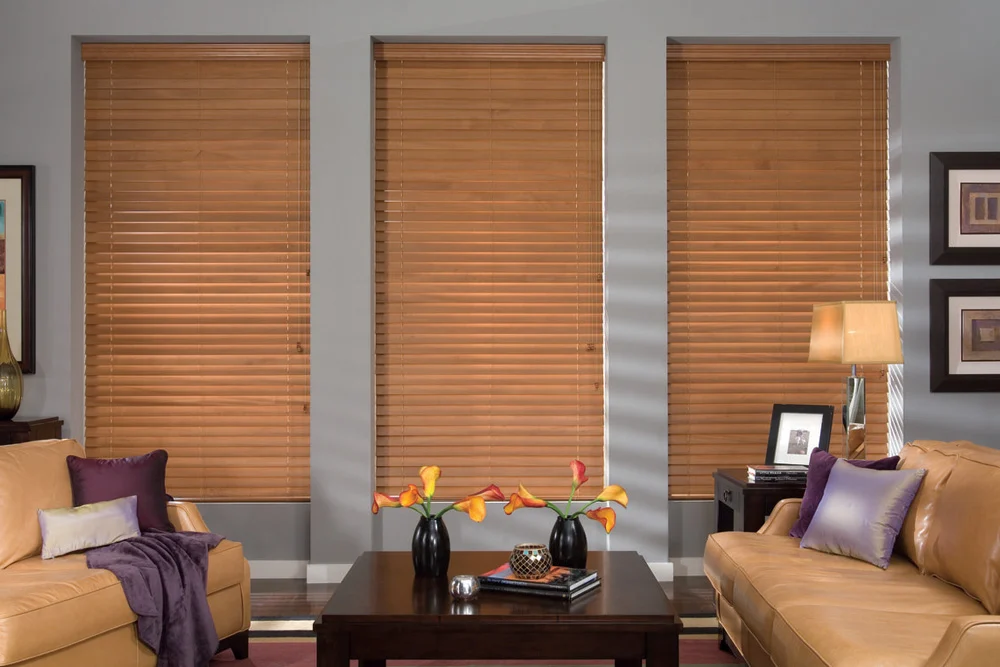
Your kitchen blinds are bowing. Your bathroom slats have a permanent curl. If you live in Kentwood or Wyoming and you installed real wood blinds in the last few years, this scene is probably familiar — and it’s not your fault. It’s the weather.
Grand Rapids sits at the intersection of two brutal climate forces: dry, Arctic-cold winters driven by polar air masses, and humid Great Lakes summers fed by moisture rolling in from Lake Michigan. That seasonal swing — sometimes a 40-plus-point change in relative indoor humidity between January and July — is a silent killer for natural wood window treatments. The wood expands, contracts, warps, and eventually cracks.
This guide is written for Grand Rapids homeowners in ranch-style and split-level homes built between the 1960s and 1980s — the kind that dominate Kentwood and Wyoming — where standard-width windows in kitchens and bathrooms take a daily beating from steam, temperature swings, and west-facing afternoon sun. By the end, you’ll know exactly which blind material is worth your investment.
Key Takeaways: Faux wood blinds resist warping, cost 20–40% less upfront than real wood, and outlast natural wood by years in moisture-prone rooms. Real wood blinds still win in dry living rooms and bedrooms where aesthetics matter most. Your room’s humidity level — not your budget alone — should drive the decision.
Why Grand Rapids Humidity Destroys the Wrong Blinds
The Great Lakes Moisture Cycle
Lake Michigan doesn’t just give Grand Haven its beautiful shoreline — it pumps moisture deep inland from late spring through early fall. Average relative humidity in Grand Rapids peaks near 80% on summer mornings (Source: NOAA National Centers for Environmental Information, 2022). That moisture enters your home through ventilation, open windows, and cooking steam. Inside a kitchen or bathroom, localized humidity can spike even higher during showers or boiling water on the stove.
Real wood is a hygroscopic material, meaning it absorbs and releases moisture from the surrounding air. When humidity rises, wood fibers swell. When the air dries out — especially during Grand Rapids winters, when Consumers Energy-heated forced-air systems strip indoor humidity down to 20–30% — those same fibers shrink. Repeat this cycle season after season and the slats warp, joints loosen, and finishes crack.
What “Humidity Damage” Actually Looks Like
You may have already noticed the signs. Individual slats that no longer lie flat when the blinds are closed create light gaps and uneven coverage. The tilt mechanism stiffens because warped slats bind against the ladder strings. In west-facing rooms that catch afternoon sun off Lake Michigan storm systems, UV exposure compounds the damage by bleaching and drying the wood surface unevenly.
According to the Wood Component Manufacturers Association, solid wood products can expand or contract up to 1% for every 4% change in relative humidity (Source: Wood Component Manufacturers Association, 2021). For a 2-inch-wide blind slat, even a small dimensional change translates directly into visible warping and operational failure.
Faux Wood vs. Real Wood: The Side-by-Side Breakdown
Composition and Moisture Resistance
Faux wood blinds are manufactured from PVC (polyvinyl chloride) or a composite blend of wood fiber and polymer resin. Neither material absorbs moisture. The slats maintain their shape whether your bathroom humidity hits 90% after a shower or your Consumers Energy furnace runs all January and drops indoor air to 20% relative humidity. They simply don’t react.
Real wood blinds are typically crafted from basswood, ramin, or paulownia — all beautiful, lightweight hardwoods. In a controlled environment like a dry bedroom or formal living room far from steam sources, they perform elegantly. But in any room where humidity regularly swings more than 20 percentage points, they are a material mismatch for the Grand Rapids climate.
Appearance and Aesthetics
Modern faux wood blinds have closed the visual gap significantly. High-quality composite slats mimic the grain texture and warm tones of natural basswood convincingly enough that most visitors can’t distinguish them from real wood without touching the slat. Real wood still earns points for tactile authenticity and slightly richer color depth — a relevant factor in formal dining rooms or home offices where you want a premium feel.
| Feature | Faux Wood Blinds | Real Wood Blinds |
|---|---|---|
| Moisture Resistance | Excellent — no warping | Poor in humid rooms |
| Weight per Slat | Heavier (PVC) | Lighter (basswood) |
| Average Lifespan (humid room) | 10–15+ years | 3–7 years |
| Upfront Cost (per window) | $30–$80 | $50–$130 |
| Warp Risk (Grand Rapids climate) | Very Low | High in kitchens/baths |
| Best Room Fit | Kitchens, baths, basements | Bedrooms, living rooms |
Maintenance in West Michigan Conditions
Faux wood blinds require only a damp cloth wipe-down. Because PVC doesn’t absorb grease or moisture, kitchen grime sits on the surface and comes off easily. Real wood blinds must be cleaned with dry or barely damp cloths and treated with occasional wood conditioner to prevent cracking. In a Wyoming ranch home where the kitchen window sits directly above a stovetop, that added maintenance burden compounds over years.
Which Blind Wins in Each Room of Your Home
Kitchens and Bathrooms: Faux Wood Wins, Full Stop
These two rooms are where the humidity battle is decided. Your kitchen window is exposed to boiling steam, dishwasher heat cycles, and cleaning sprays. Your bathroom window endures daily condensation from hot showers. Faux wood blinds are the only rational choice for these spaces in a Grand Rapids home.
- Steam from cooking raises localized humidity to 70–90% within minutes
- Shower humidity spikes can sustain 85%+ relative humidity for 20+ minutes per session
- West-facing bathroom windows also absorb summer afternoon heat, accelerating wood degradation
- PVC and composite faux wood maintain dimensional stability across temperature ranges from 20°F to 120°F (Source: Plastics Industry Association, 2020)
Bedrooms and Living Rooms: Real Wood Is Competitive Here
Bedrooms and interior living rooms in Kentwood split-levels typically maintain more stable humidity levels — especially if your home has a whole-house humidifier on your Consumers Energy heating system. In these rooms, real wood’s lighter weight is a practical advantage for large window spans, and the authentic grain appearance justifies the premium price. If your bedroom windows aren’t west-facing and don’t receive direct bathroom steam, real wood is a viable and beautiful option.
Basements and Bonus Rooms: Go Faux Without Debate
Basements in Grand Rapids-area homes are notorious for moisture infiltration, particularly during spring snowmelt when soil saturation pushes ground moisture through concrete block foundations. The U.S. Environmental Protection Agency notes that indoor relative humidity above 60% promotes mold growth on porous materials (Source: U.S. Environmental Protection Agency, 2023). Real wood in a basement is an invitation for mold colonization on the back face of slats — a health risk you don’t want near your family’s living space.
Long-Term Cost and Value in a West Michigan Home
Replacement Cycles Tell the Real Story
Homeowners who install real wood blinds in their Grand Rapids kitchens often replace them within 4–6 years due to warping. At an average installed cost of $90 per window for real wood, two replacement cycles over 12 years cost $180 per window. Quality faux wood blinds installed once at $55 per window and maintained properly can last 12–15 years in the same space — a savings of over $120 per window over the same period. Multiply that across a 1960s ranch home with six kitchen and bathroom windows, and the math becomes very compelling.
Energy Efficiency and Consumers Energy Bills
Window treatments contribute meaningfully to home energy efficiency. The U.S. Department of Energy reports that cellular shades and fitted blinds can reduce heat loss through windows by up to 40% in winter conditions (Source: U.S. Department of Energy, 2023). While both faux wood and real wood blinds provide similar insulating performance when closed, faux wood’s warp resistance ensures a tighter fit against the window frame throughout its entire lifespan — preserving that efficiency benefit year after year without the slat-gap issues that warped real wood creates. For Grand Rapids homeowners managing winter heating costs through Consumers Energy, that sustained tight fit adds up.
Resale Value Considerations
The National Association of Home Builders notes that window treatment upgrades are among the top 10 cosmetic features buyers notice during home tours (Source: National Association of Home Builders, 2022). Faux wood blinds in excellent condition signal a well-maintained home. Warped, discolored real wood blinds in a kitchen — a room buyers scrutinize closely — signal deferred maintenance, even if everything else is updated. In Kentwood and Wyoming’s competitive resale market, your blinds are part of your first impression.
Ready to stop guessing? Our team serves Grand Rapids homeowners with free in-home assessments that account for your specific rooms, window orientations, and humidity exposure. Schedule your free in-home consultation today and get a product recommendation tailored to your home — not a generic national guide.
Why Grand Rapids Homeowners Trust Our Local Expertise
- Hyper-local climate knowledge: We account for your home’s specific orientation relative to Lake Michigan moisture patterns and prevailing wind directions
- Neighborhood-specific experience: We’ve assessed hundreds of ranch and split-level homes in Kentwood and Wyoming — we know the window configurations, the humidity zones, and the installation quirks
- Product honesty: We don’t upsell real wood where faux wood is the smarter choice. Your long-term satisfaction matters more than a higher ticket sale
- Warranty-backed installations: Our faux wood blind installations carry a manufacturer defect warranty plus our own workmanship guarantee
Two local homeowners who went through this same decision:
Karen M., Kentwood had real wood blinds in her 1974 ranch-style kitchen that warped within three years. After switching to a composite faux wood product in a natural walnut finish, she reported zero warping after two full seasonal cycles and estimated she saved roughly $340 in avoided replacement costs across her four kitchen and bathroom windows.
David R., Wyoming kept real wood blinds in his master bedroom — a dry, north-facing room — but replaced his bathroom and laundry room blinds with moisture-resistant faux wood composites. He noted the bathroom blinds still operate smoothly after 18 months, whereas the previous real wood set had stiffened significantly within the first summer.
Frequently Asked Questions
Can faux wood blinds be painted or stained to match updated decor?
PVC-based faux wood blinds are not ideal candidates for painting because standard latex and oil-based paints don’t bond well to smooth PVC without a dedicated adhesion primer. Composite faux wood (wood fiber plus polymer) accepts paint slightly better but can still produce uneven results. If color-matching future decor updates matters to you, select a neutral factory finish — like white or warm gray — that coordinates with multiple design directions, rather than attempting to repaint the slats later.
Do faux wood blinds off-gas VOCs or odors in an enclosed bathroom?
PVC manufacturing does involve chemical compounds, but finished faux wood blind products sold in the U.S. market must comply with California Air Resources Board (CARB) Phase 2 standards for formaldehyde emissions, which are widely adopted by national manufacturers even outside California (Source: California Air Resources Board, 2023). Most off-gassing dissipates within the first few days after installation in a ventilated room. If chemical sensitivity is a concern, composite wood-polymer blends typically carry lower VOC profiles than pure PVC alternatives.
Are there faux wood blind options wide enough for the large picture windows in 1970s ranch-style homes?
Yes — and this is where faux wood has a practical limitation worth knowing upfront. PVC slats are heavier per linear inch than basswood, so very wide blinds (over 72 inches) can sag at the center span over time under their own weight. For wide picture windows common in 1960s–1980s Grand Rapids ranch homes, look for manufacturers that offer a center support feature, or consider installing two narrower blind panels side by side on a wide window rather than one oversized unit. A professional measurement visit will flag this before you order.
How do I tell if my current real wood blinds are warped from humidity versus just dirty or misaligned?
Close the blinds fully and stand back three feet. If light leaks unevenly through the slats in a pattern that isn’t consistent across the full width — particularly bowing outward at the center of individual slats — that’s warping, not misalignment. Misalignment typically shows as a uniform tilt across all slats simultaneously, which is correctable by adjusting the tilt rod. Warped individual slats that bow or cup cannot be reversed; the moisture damage to the wood fiber is permanent and the slats need replacement.
The Bottom Line for Your Grand Rapids Home
Grand Rapids is not Phoenix. It’s not Denver. The specific combination of Great Lakes summer humidity, Arctic-cold dry winters, and the west-facing moisture exposure that comes with living near Lake Michigan’s reach creates a window treatment challenge that generic national buying guides simply don’t address. Faux wood blinds are the durable, cost-effective answer for your kitchens, bathrooms, and basements. Real wood still earns its place in dry bedrooms and formal living rooms where authenticity matters and humidity stays stable.
The worst outcome is choosing by appearance alone, installing real wood in your Kentwood kitchen, and watching it bow by the following July. Don’t rely on a national article written for a climate nothing like ours.
Not sure which blind material survives Grand Rapids humidity best? Call our local experts for a free in-home assessment and product recommendation today. We’ll walk through every window in your home, assess your humidity exposure zone by zone, and give you an honest recommendation — no pressure, no upsell. Get your free in-home assessment now.
Frequently Asked Questions
Can faux wood blinds be painted or stained to match updated decor?
PVC-based faux wood blinds don’t bond well with standard paints without a dedicated adhesion primer, making repainting unreliable. Composite faux wood accepts paint slightly better but results are still inconsistent. The better strategy is to choose a neutral factory finish — white or warm gray — that coordinates across multiple decor changes without requiring you to refinish the slats.
Do faux wood blinds off-gas VOCs or odors in an enclosed bathroom?
Finished faux wood blind products sold in the U.S. must comply with California Air Resources Board (CARB) Phase 2 formaldehyde emission standards, which most national manufacturers follow regardless of where the product is sold (Source: California Air Resources Board, 2023). Any residual off-gassing typically clears within a few days in a ventilated space. Homeowners with chemical sensitivities may prefer composite wood-polymer blends, which generally carry a lower VOC profile than pure PVC products.
Are there faux wood blind options wide enough for the large picture windows in 1970s ranch-style homes?
Wide faux wood blinds are available, but PVC slats are heavier per linear inch than basswood, which can cause center-span sagging on units wider than 72 inches over time. For the large picture windows common in Grand Rapids-area ranch homes built in the 1960s and 1970s, consider installing two narrower panels side by side rather than one oversized unit, or select a manufacturer that includes a center support bracket. A professional in-home measurement visit will identify this issue before you place an order.
How do I tell if my current real wood blinds are warped from humidity versus just dirty or misaligned?
Close the blinds completely and step back about three feet. Uneven light gaps that vary from slat to slat — particularly a bowing or cupping pattern at the center of individual slats — indicate moisture warping. Misalignment, by contrast, appears as a uniform tilt across all slats simultaneously and can be corrected by adjusting the tilt rod. Warped slats cannot be reversed; the dimensional change from moisture cycling is permanent and the affected slats require full replacement.